

A toilet sample is sitting in the meeting room, and the quotation says “MaP 1000g.” The number looks reassuring. It is also easy to misuse. One buyer may read it as proof that the toilet has the strongest possible flush. Another may assume it covers bowl washing, noise, water use, drainline performance, and every production unit that carries a similar model name. None of those conclusions follows from the number alone. For a buyer, the useful question is narrower: what exactly was tested, which model passed, at what flush volume, and does that tested configuration match the toilet you are ordering?
What A MaP Score Actually Measures
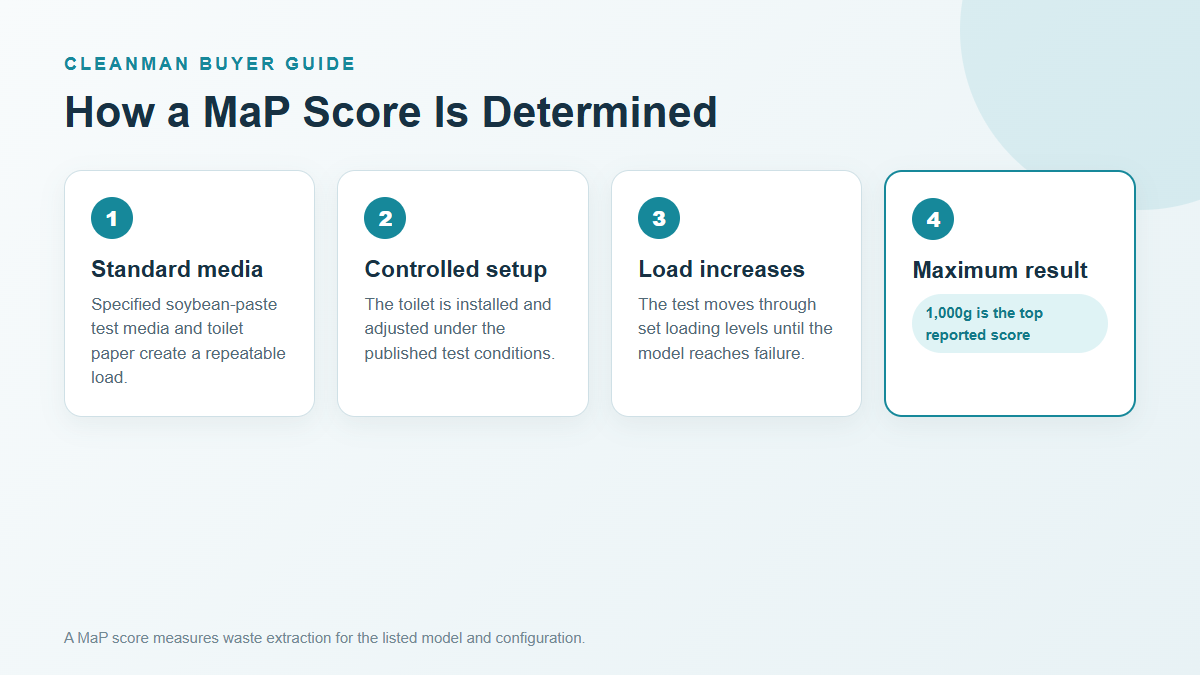
MaP stands for Maximum Performance. The test measures how much standardized soybean-paste media a toilet can remove from the bowl in one flush under controlled conditions. The loading is increased in set steps until the toilet reaches its maximum successful level, with 1,000 grams as the top score reported by the program. The official MaP protocol defines the score as the maximum media loading that the tested model clears successfully. Depending on the approved test medium, the model must clear all media in at least four of five attempts or two of three attempts. A clog, an incomplete clearance, or failure to restore the required trap seal counts as a failed test. So a 1,000g result has a clear meaning: the submitted toilet configuration reached the upper end of the MaP waste-extraction test. It does not mean that a bathroom user is expected to flush one kilogram of waste. It is a standardized way to compare tested models. MaP publishes its method and model listings through MaP Toilet Testing.
A 1000g Score Is Strong Evidence, But It Is Not The Whole Toilet
Waste extraction matters. Buyers do not want complaints about repeated flushing or a bowl that blocks easily. Still, MaP is one test lens. A MaP score does not, by itself, tell you how evenly water washes the bowl surface. It does not give you a noise rating, glaze inspection result, seat durability result, carton-drop result, or installation clearance. It also does not replace checks for water consumption, certification, dimensional fit, or spare-part compatibility. This distinction matters in a comparison sheet. If one column says “MaP 1000g” and another says “quiet flush,” those are different claims supported by different evidence. Do not combine them into a general phrase such as “best flushing toilet” unless you have a defined comparison and the documents to support it.
MaP 1000g And WaterSense Are Related, Not Interchangeable
The two terms often appear beside each other in North American toilet documents, which is why buyers sometimes treat them as one approval. EPA WaterSense requires tank-type toilets to meet water-efficiency and performance criteria. Its waste-extraction requirement uses 350 grams of soybean-paste media plus toilet paper. MaP testing can continue beyond that threshold and records the maximum cleared load, up to 1,000 grams. The practical difference is simple:
| Document or result | What it tells the buyer | What it does not prove by itself |
|---|---|---|
| MaP 1000g score | The listed model reached 1,000g in the MaP waste-extraction test | WaterSense certification, bowl wash, noise, packaging, or every related configuration |
| WaterSense label | The certified model meets WaterSense water-efficiency and performance requirements | That its MaP maximum score is 1,000g |
| cUPC or other plumbing certification | The listed product complies with the scope of the applicable certification | A specific MaP score unless the MaP listing is also checked |
| Factory sample test | The inspected sample performed under the factory’s stated conditions | Independent listing or continuing compliance of all production without controls |
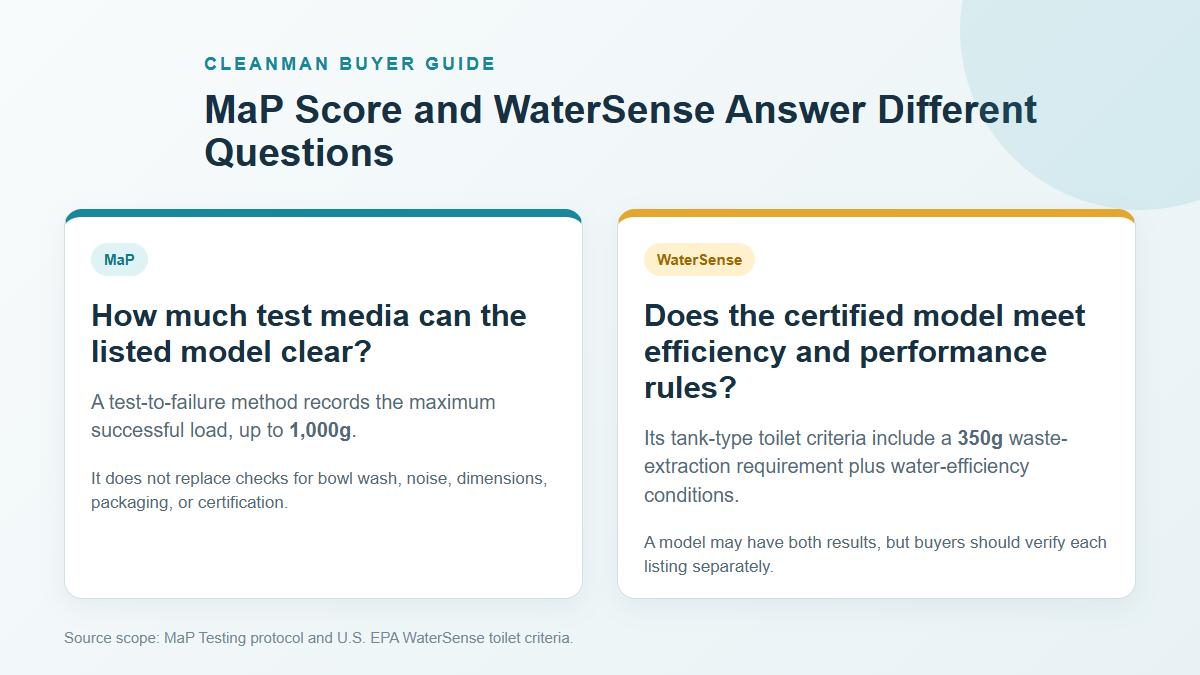
The EPA also separates waste extraction from bowl-surface cleaning, mixed-media flushing, and drainline transport in its explanation of toilet performance. You can review those distinctions on the EPA WaterSense residential toilets page.
Match The Listing To The Exact Model
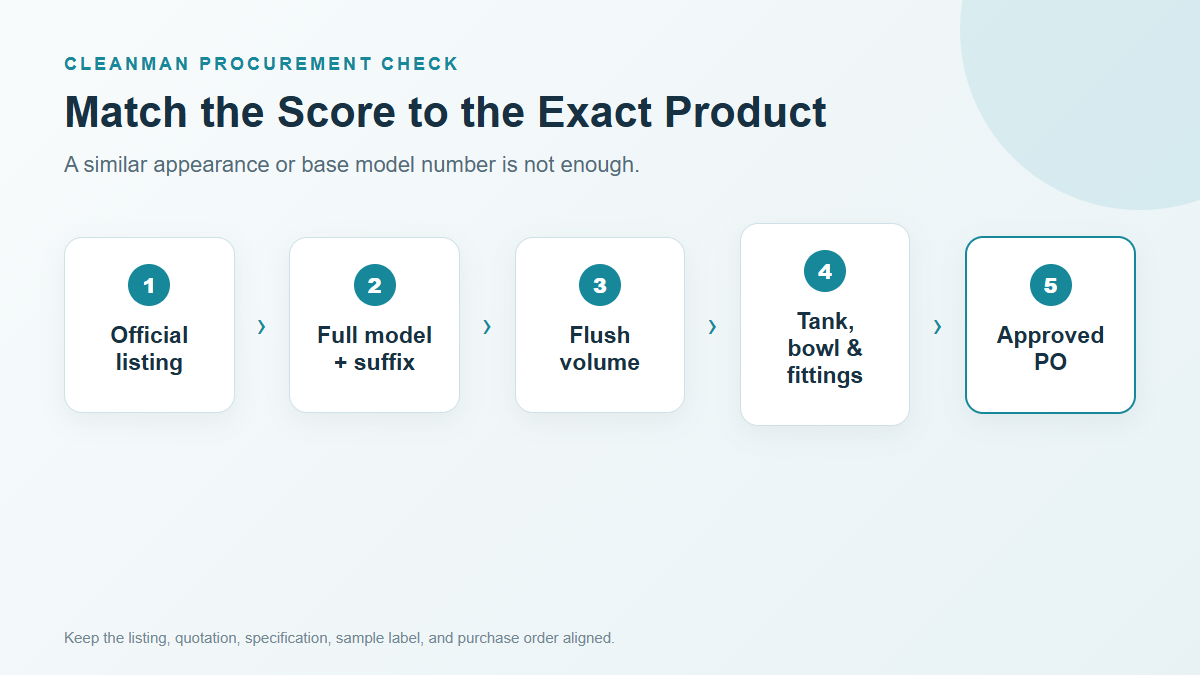
This is where a strong-looking number can become weak paperwork. Imagine that your quotation lists model CL-X with a 1.0/1.28 gpf tank fitting, while the test report covers CL-XA with another tank or flush valve. The bowls may look identical in photographs. The tested configuration is still not automatically the quoted configuration. Before you approve the claim, compare:
- manufacturer or brand name shown in the listing;
- complete model number, including suffixes;
- one-piece or two-piece construction;
- tank and bowl combination, where listed separately;
- rated flush volume;
- gravity, pressure-assist, or other flushing arrangement; and
- any notes attached to the official listing.
Suffixes deserve attention. They can indicate a different tank fitting, button arrangement, seat package, color, or market configuration. Sometimes the change does not affect the tested hydraulic platform. Sometimes it does. Ask the supplier to explain the relationship and provide documents that connect the quoted configuration to the listed model.
CLEANMAN Models In The Official MaP List
The MaP published list contains several CLEANMAN one-piece toilet models with a 1,000g score. Examples include CL-12335A and CL-12248A. The official list also contains other CLEANMAN model numbers, but a buyer should always use the latest listing and match the exact model rather than copying a score across the range. This is especially important when a product family has several versions. A shared ceramic appearance or a similar base model number is not enough. The quotation, specification sheet, sample label, certification record, and MaP listing should point to the same configuration or show a documented relationship. For current sourcing, ask CLEANMAN for the exact supporting file tied to the model under discussion. Do not rely on an old catalog screenshot when the public listing can be checked directly.
Use The Score At The Right Stage Of Buying
The MaP score is most useful during shortlisting. It helps you separate a documented waste-extraction result from a vague sales statement such as “powerful flush.” It should not be the final approval on its own. Once a model reaches your shortlist, the work becomes more practical. Check the bowl wash, water spot, refill behavior, flush volume, operating noise, seat fit, dimensions, rough-in, and access to replacement tank fittings. If the product is for a project, compare those points with the actual room and maintenance plan. A sensible sample review can include repeated flushes under the agreed water supply conditions. Record the tank setting and fittings used. Factory sample testing is not a replacement for an independent MaP result, but it can confirm that the commercial sample matches the configuration you expect to receive.
Put The Claim Into The Order Documents
If MaP performance helped you choose the model, do not leave it in an email thread. Put the exact reference into the approved product specification. A useful confirmation line can identify:
- the full toilet model and configuration;
- the rated flush volume;
- the official MaP score and listing reference;
- the approved tank fitting or flush mechanism;
- the certification documents required for the destination market; and
- the action required if a component change is proposed before shipment.
The last point matters. A factory may have a valid reason to replace a fitting because of supply, regulation, or customer preference. The buyer still needs to know whether that change affects the tested configuration or any claim printed on the carton and product page.

Five Questions To Ask Before Accepting “MaP 1000g”
Do not ask only for a test-report photo. Ask questions that connect the score to your order:
- What is the exact model number in the current MaP listing?
- Does my quoted toilet use the same bowl, tank, flush volume, and flushing components?
- Is the model also WaterSense listed or otherwise certified for my target market, if required?
- Which performance points have separate evidence, such as bowl wash or water consumption?
- How will CLEANMAN control and approve component changes during production?
Those questions turn a large number into usable purchasing evidence.
The Buyer’s Takeaway
A MaP 1000g score is meaningful. It shows that the listed toilet reached the top reported loading in a recognized waste-extraction test. That is much better than an unsupported “strong flush” claim. But the score belongs to a listed model and configuration. It is not a blanket promise for every similar-looking toilet, and it does not cover every part of toilet performance. Match the listing, review the remaining product evidence, and carry the confirmed claim into the purchase order. You can review the broader CLEANMAN toilet range or read our guide to commercial toilets for public projects before sending the model, destination market, flush-volume requirement, and project quantity for comparison.
Często zadawane pytania
1. Does A MaP 1000g Score Mean My Toilet Will Never Clog?
No. The score reports performance under a controlled test method. Real installations vary in drain condition, water supply, setup, use, and maintenance. You should treat the score as model-level test evidence, not a no-clog guarantee.
2. Is MaP 1000g The Same As WaterSense Certification?
No. MaP reports maximum waste-extraction performance. WaterSense is a labeling program with water-efficiency and performance requirements. A model can have both, but you must verify each listing separately.
3. Can I Use One MaP Report For Every Model In The Same Toilet Series?
Only when the documentation clearly covers those models or establishes an accepted relationship between them. You should not transfer the score based on appearance or a similar model number.
4. Should I Choose A 1000g Toilet Over Every Lower-Scoring Model?
Not automatically. Your decision also depends on water use, bowl cleaning, dimensions, price, certification, seat and fitting quality, packaging, and service needs. The MaP score answers one important question, not the whole purchase decision.
5. What Documents Should I Request With A MaP Claim?
Ask for the current official listing or report reference, the exact product specification, applicable certification records, and confirmation of the production configuration. The model numbers and flush volume should agree across those documents.

