


The project schedule says “chair height toilet.” The supplier drawing says the ceramic is 410 mm high. The sample arrives with a seat that changes the final number. At that point, the buyer is no longer comparing like with like.
That is the practical problem behind the chair height toilet vs standard question. The labels are useful for narrowing a product search, but they are not complete specifications. For an importer, distributor, or project buyer, the decisive number is usually the installed height from the finished floor to the top of the seat.

Start with the measurement, not the label
“Standard height,” “chair height,” “comfort height,” and “right height” can appear in catalogs and retail listings. Their exact use varies by brand and market. A buyer should not assume that two products carrying the same label have the same installed seat height.
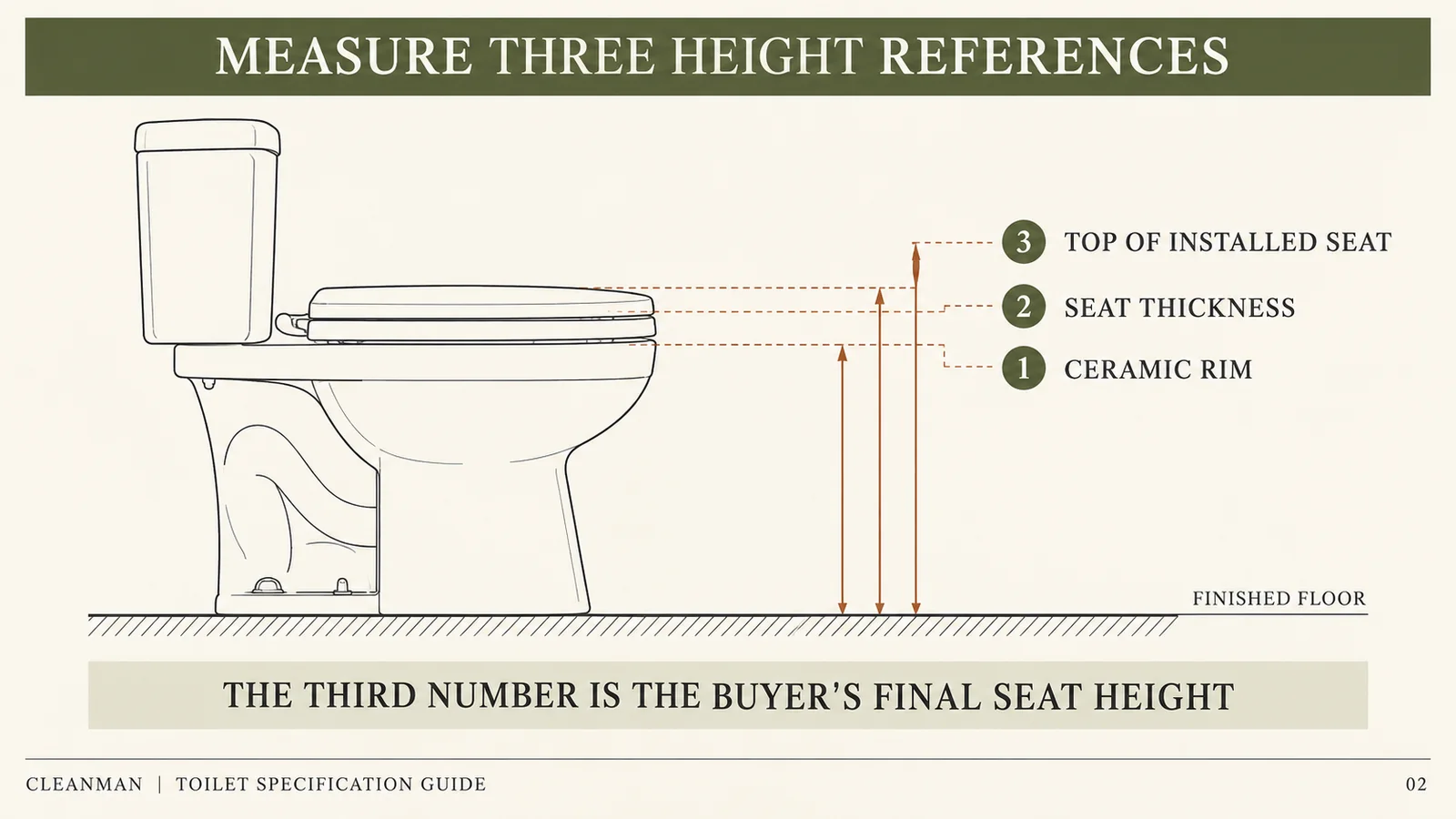
The drawing should separate at least three references:
- height from the finished floor to the ceramic rim;
- seat thickness or the installed seat specification;
- height from the finished floor to the top of the installed seat.
The third number is the one people experience when they sit down. It is also the reference used in the U.S. accessibility guidance discussed below. If the quotation shows only the ceramic height, ask for a revised drawing or a written seat-height confirmation before sample approval.
Chair height toilet vs standard height: what the terms tell you
| Catalog term | What it usually signals | What the buyer still needs |
|---|---|---|
| Standard height toilet | A conventional residential-height format in that supplier’s range | Exact installed seat height and the model drawing |
| Chair height toilet | A taller seating position relative to lower conventional options | Exact installed seat height, seat specification, and project requirement |
| ADA height or accessible height | A claim that should be tied to an applicable standard and installation | Documented dimensions plus the full accessibility review, not height alone |
This is why a search for what is chair height toilet should end with a dimension, not another marketing phrase. A useful quotation identifies the exact model, seat, drawing revision, and measurement datum.
Chair height is not automatically ADA compliant
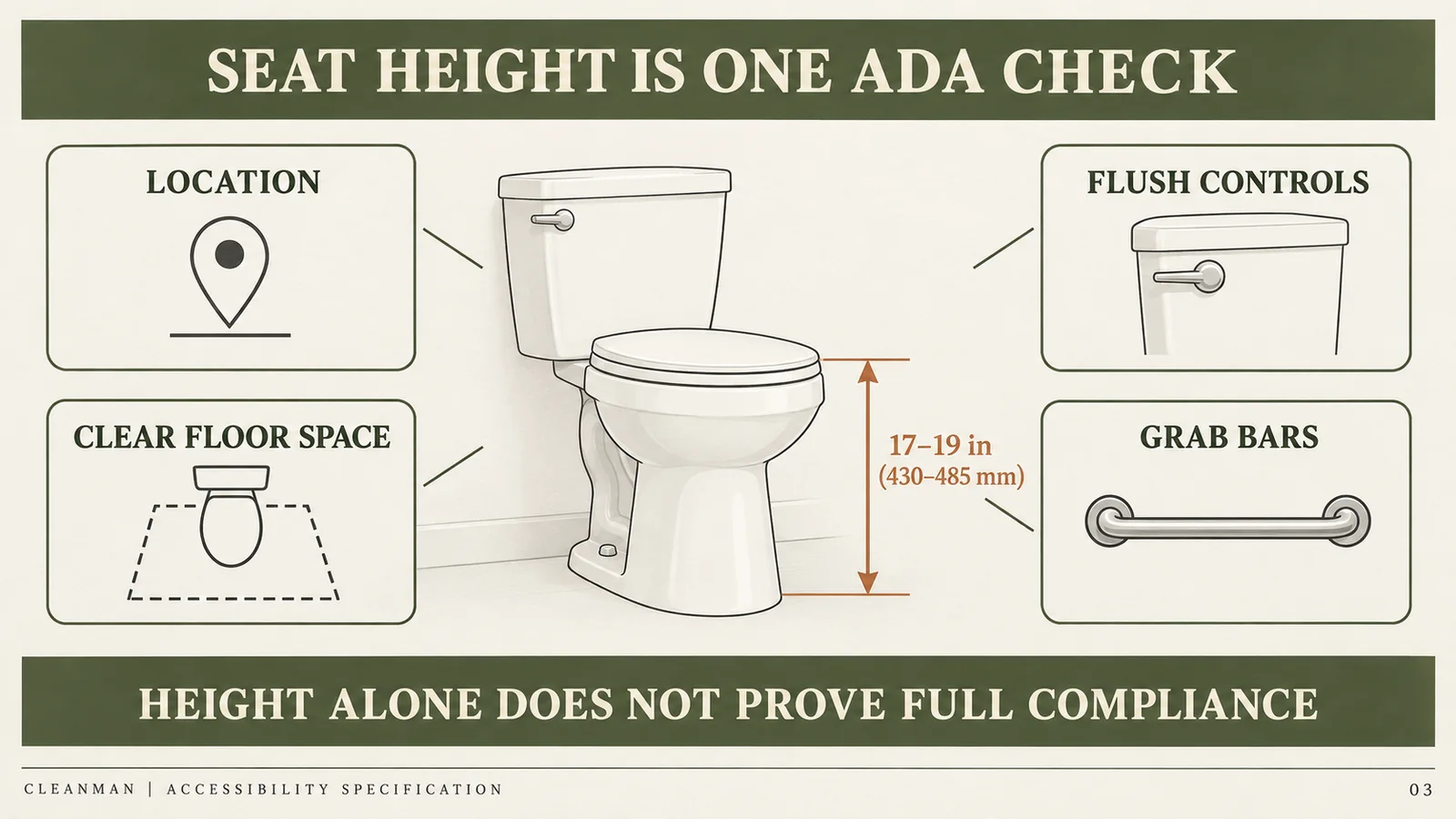
For accessible water closets covered by the U.S. ADA Standards, the top of the seat must be 17 to 19 inches, or approximately 430 to 485 mm, above the finished floor. The measurement is taken to the top of the seat.
However, passing that height check does not prove that a toilet room is ADA compliant. The installation also involves factors such as the water-closet location, clear floor space, flush-control position, grab bars, and other room conditions. The official U.S. Access Board toilet-room guide should be read with the project requirements and local authority guidance.
For buyers, the wording matters. “Seat height is within the specified range” is a dimensional statement. “ADA compliant” is a broader claim that requires a full product-and-installation review. Cleanman also has a separate ADA-compliant toilet guide for buyers who need that wider context.
Which height should a buyer shortlist?
There is no universal winner. The correct shortlist depends on the destination market, the project schedule, the intended installation, and the product mix the buyer wants to carry.
Standard-height products may fit when
The tender or local market already uses a conventional lower format, replacement compatibility is important, or the buyer is matching an established retail assortment. The relevant question is not whether the product is “normal,” but whether its exact installed dimensions match the requirement.
Chair-height products may fit when
The specification calls for a taller seating position, the distributor wants a height option within the range, or a project has a defined seat-height target. A taller label alone is not enough; it must still be connected to the correct seat and drawing.
For mixed projects, it can be sensible to approve more than one height category while keeping the bowl shape, color, flushing format, and spare-parts plan coordinated. Buyers can review the current Cleanman toilet range and then request the exact drawings for the models under consideration.
The seat can change the approved number
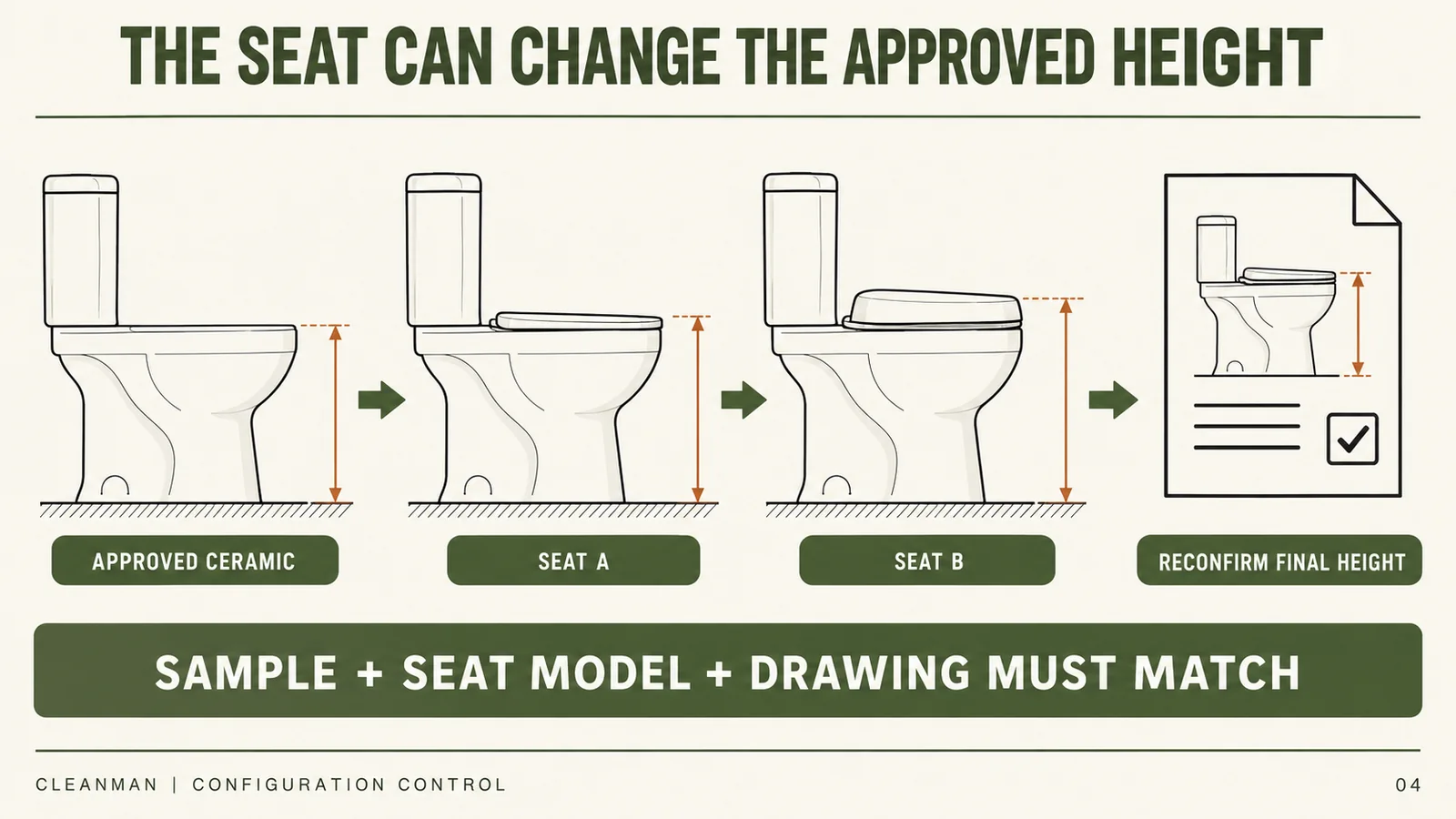
A specification often focuses on the ceramic body because that is the largest component on the drawing. But the installed seat completes the user-facing height. Changing from one seat design to another can alter the final measurement, even when the ceramic remains unchanged.
That creates a simple control point for purchasing: the approved sample, approved seat, and approved dimensional drawing should refer to the same configuration. If the seat is substituted later, the supplier should reconfirm the finished-floor-to-seat-top dimension.
Put the height requirement into the RFQ
A short, measurable RFQ line prevents a long argument after production. Instead of writing only “chair height,” ask the supplier to confirm:
- model number and drawing revision;
- finished-floor-to-top-of-installed-seat height in millimeters;
- ceramic rim height and seat model;
- measurement tolerance;
- rough-in and trap configuration;
- bowl shape, flushing system, and water-use specification;
- the standard or project clause used for any accessibility claim;
- whether the production sample matches the quoted drawing.
For multi-market programs, keep each destination’s requirement on a separate line. A height accepted for one sales channel should not be silently carried into another country’s quotation.
Questions to settle before placing the order
When the buyer and supplier review the same drawing, the discussion becomes much faster. A useful chair height toilet vs standard comparison confirms the measurement datum, the installed seat, and the exact claim that will appear in the catalog. Then it connects those details to the rough-in, flushing, packaging, and certification requirements of the project.
If your schedule currently says only “standard height” or “chair height,” send Cleanman the target dimensions and destination market through the project inquiry page. The team can use those details to narrow the relevant models and documentation.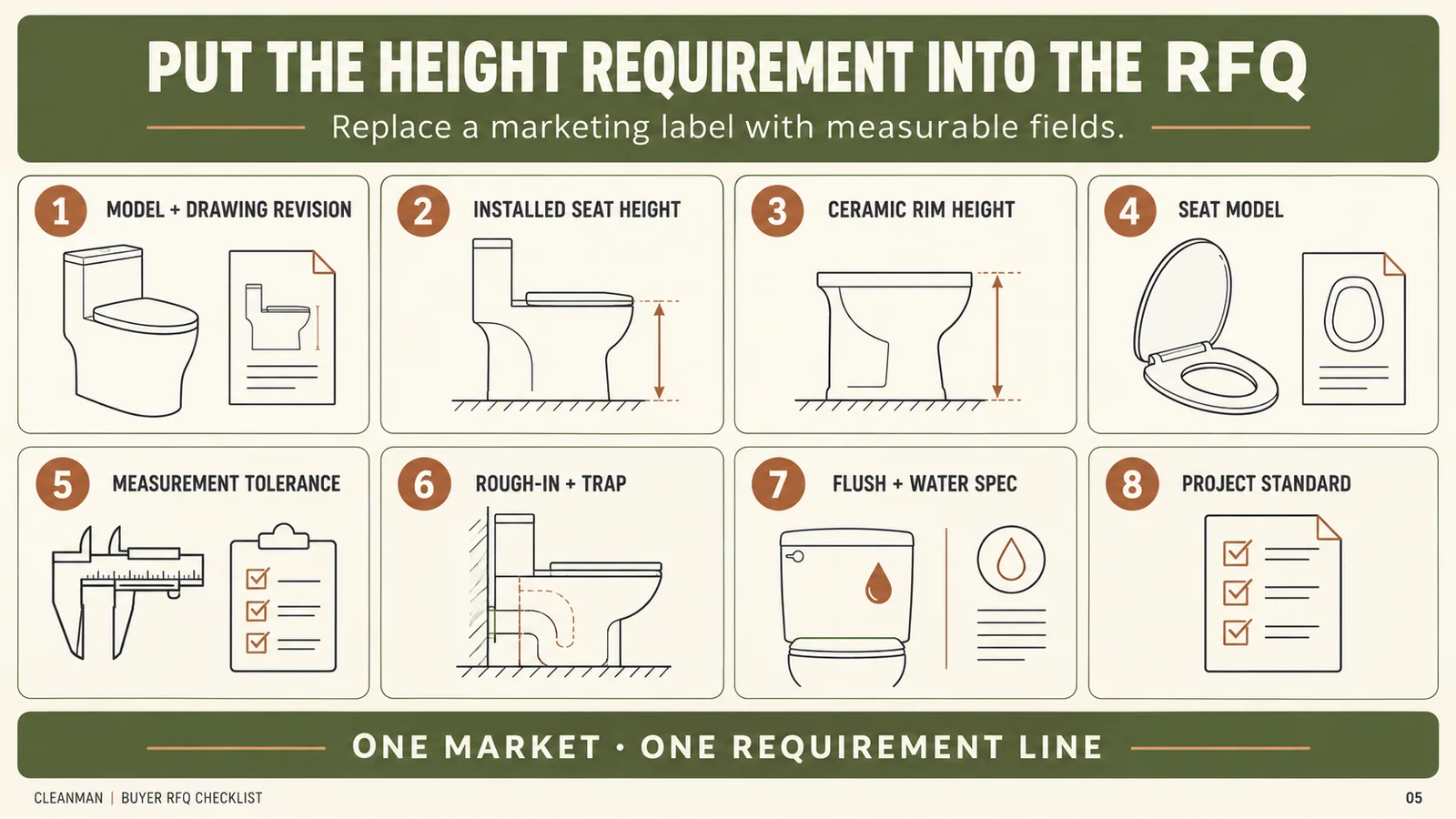
Frequently Asked Questions
1. What is a chair height toilet?
It generally means a toilet with a taller seating position than lower conventional products in the same market or product range. Because the term is not a complete dimensional standard, confirm the height from the finished floor to the top of the installed seat.
2. What is standard toilet height?
The label usually describes a conventional height within a brand or market, but the exact number can vary. Use the model drawing and installed seat height rather than relying on the label alone.
3. Is chair height the same as ADA height?
No. A chair-height label does not by itself establish ADA compliance. The ADA seat-height range is one requirement within a broader set of product and installation conditions.
4. How is toilet seat height measured?
Measure vertically from the finished floor to the top of the installed seat. Do not use only the ceramic rim height when the project requirement refers to seat height.
5. Should the toilet seat be included in the approved sample?
Yes, when seat height is part of the specification. The seat affects the final installed dimension, so the sample, seat model, and drawing should match.
6. What should a buyer send the manufacturer?
Send the target installed seat height, destination market, applicable project standard, rough-in and trap requirement, bowl shape, flushing requirement, and expected order scope. Ask for the exact model drawing and configuration confirmation in return.


