

You receive two toilet quotations that look almost identical. Both models are white ceramic, both use the same nominal flush volume, and both fit the target price range. One supplier calls its model siphonic. The other calls it washdown. Your siphonic vs washdown toilet comparison needs to go beyond the name on each quotation.
If the decision affects only one bathroom, choosing the wrong flushing system may mean one user dislikes the experience or one toilet has to be replaced. But when you are approving a hotel project, distributor range, or container order, the same choice is repeated across dozens, hundreds, or even thousands of units. If the water surface, discharge pattern, operating sound, or bowl-cleaning behavior does not match market expectations, rework and after-sales costs can rise quickly.
The right question is not whether siphonic or washdown is universally better. You need to decide which system fits the plumbing conditions, customer expectations, regulations, and price position of your market.
What Is a Siphonic Toilet?
A siphonic toilet uses a curved trapway and a siphon action to draw water and waste from the bowl. When the flush starts, water enters the bowl and fills the trapway. As the water moves through the bend, it creates the pulling action that helps empty the bowl.
This design normally uses a relatively narrow and longer trapway. It also tends to maintain a larger water surface in the bowl. That water surface can help reduce visible marks and contain odors, although the final result still depends on the complete bowl and flushing design.
Siphonic toilets are common in markets where buyers expect a higher bowl water level and a quieter, smoother flush. Many North American tank-type toilets use some form of siphonic action, but you should verify the exact model rather than infer the flushing system from its destination market.
What Is a Washdown Toilet?
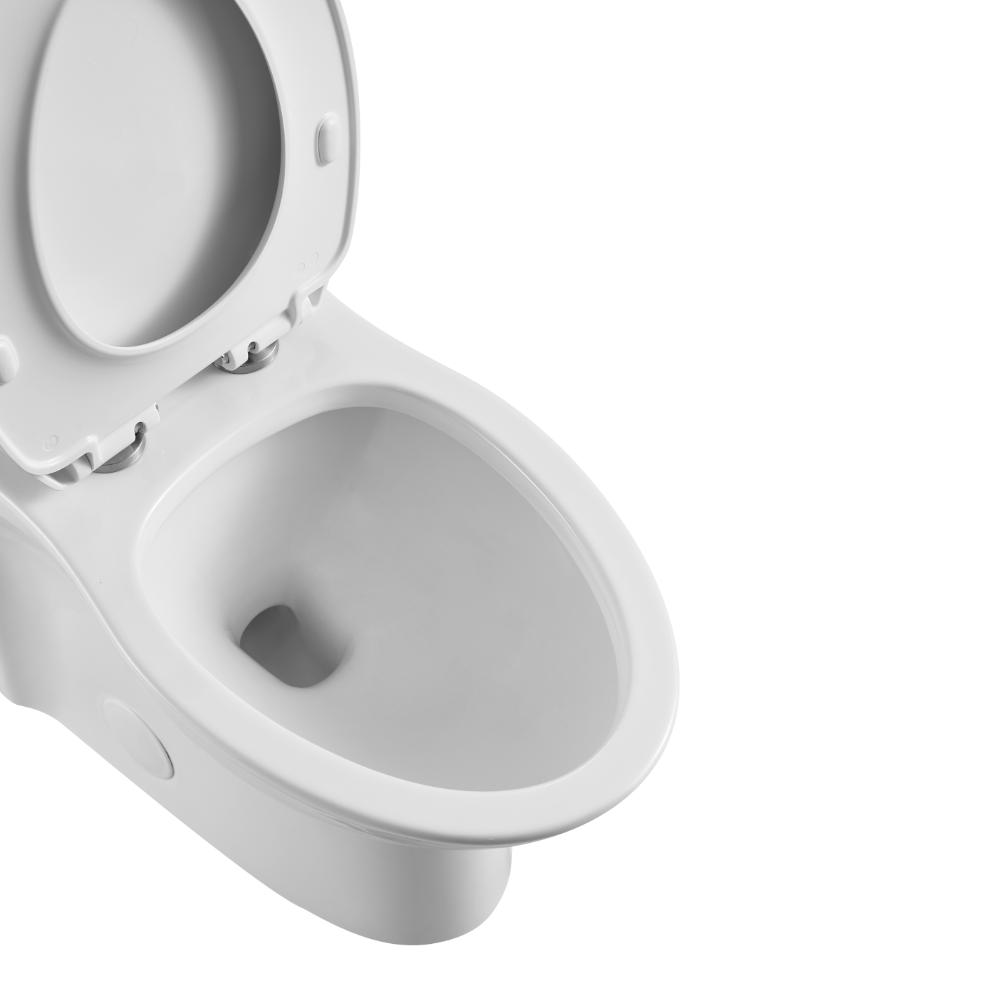
A washdown toilet uses the force of water entering the bowl to push waste directly through a shorter, usually wider trapway. It does not depend on the same sustained siphon action.
The simpler waste path can provide a large outlet and fast discharge. Washdown toilets commonly have a lower water level in the bowl. They are widely used in many European, Asian, African, and Middle Eastern markets, especially where buyers value a direct flush, simple internal geometry, and compatibility with different outlet arrangements.
The words “washdown” and “rimless” are not interchangeable. Washdown describes how waste moves through the outlet. Rimless describes the structure around the top edge of the bowl. A toilet can be washdown and rimless, but one term does not prove the other.

Siphonic vs Washdown Toilet: The Main Differences
| Buying point | Siphonic toilet | Washdown toilet |
|---|---|---|
| Waste movement | Siphon action pulls waste through the trapway | Water flow pushes waste through the outlet |
| Trapway | Usually longer and narrower | Usually shorter and wider |
| Bowl water surface | Generally larger | Generally smaller |
| Flush character | Longer, smoother draw | Faster, more direct discharge |
| Sound | Often perceived as softer | Can sound sharper, depending on design |
| Outlet specification | Confirm the exact floor- or wall-outlet model and dimensions | Confirm the exact floor- or wall-outlet model and dimensions |
| Buyer priority | Water surface, user familiarity, smoother flush experience | Direct discharge, simpler waste path, regional familiarity |
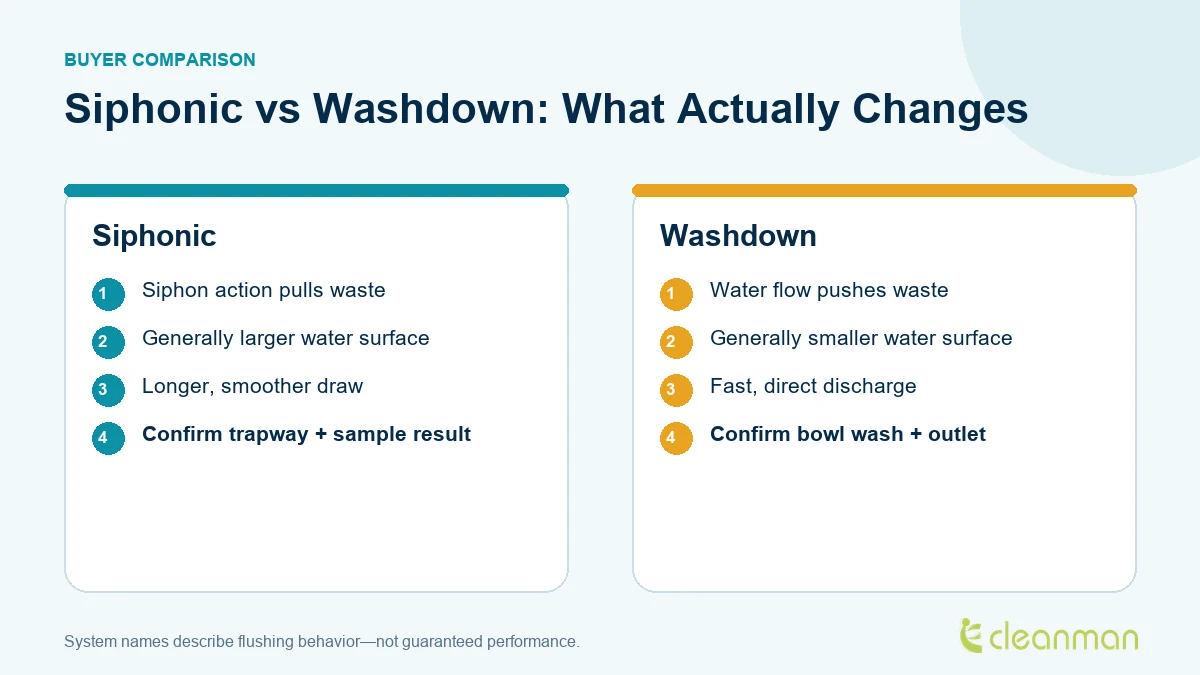
These are useful tendencies, not purchase guarantees. A well-designed washdown toilet can outperform a weak siphonic model, and a strong siphonic model can clear waste reliably at a low flush volume. You still need model-specific drawings and test evidence.
1. Start With the Project’s Drainage Arrangement
Before comparing flushing claims, confirm where the building receives the waste outlet.
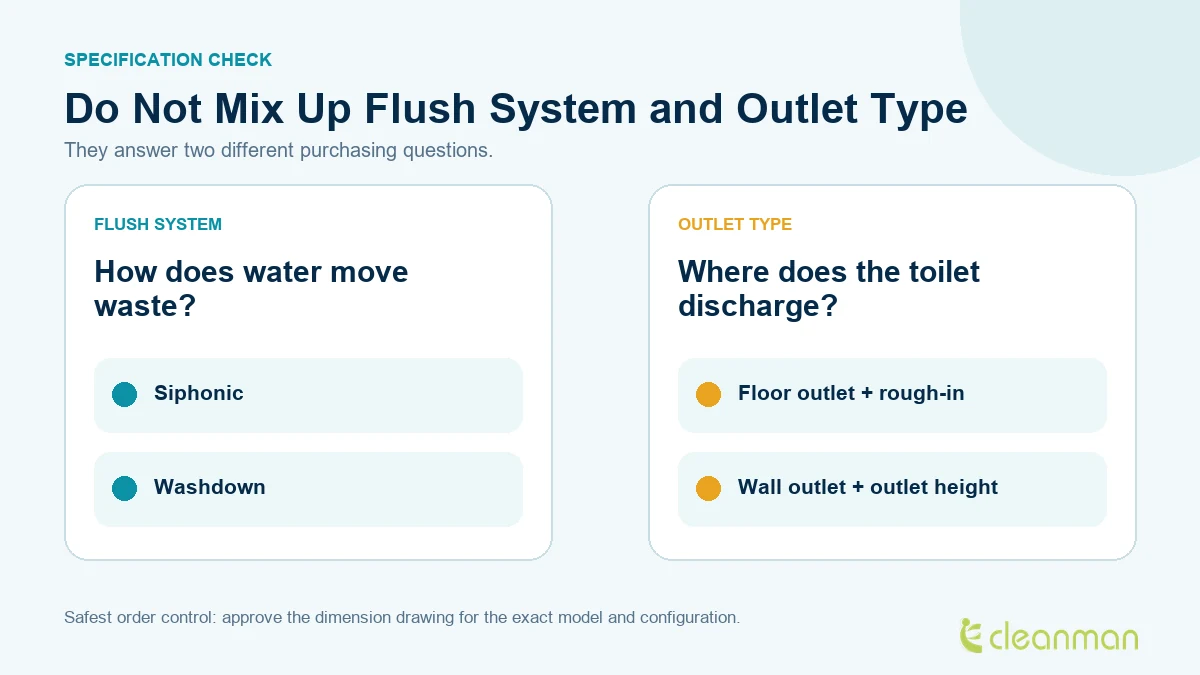
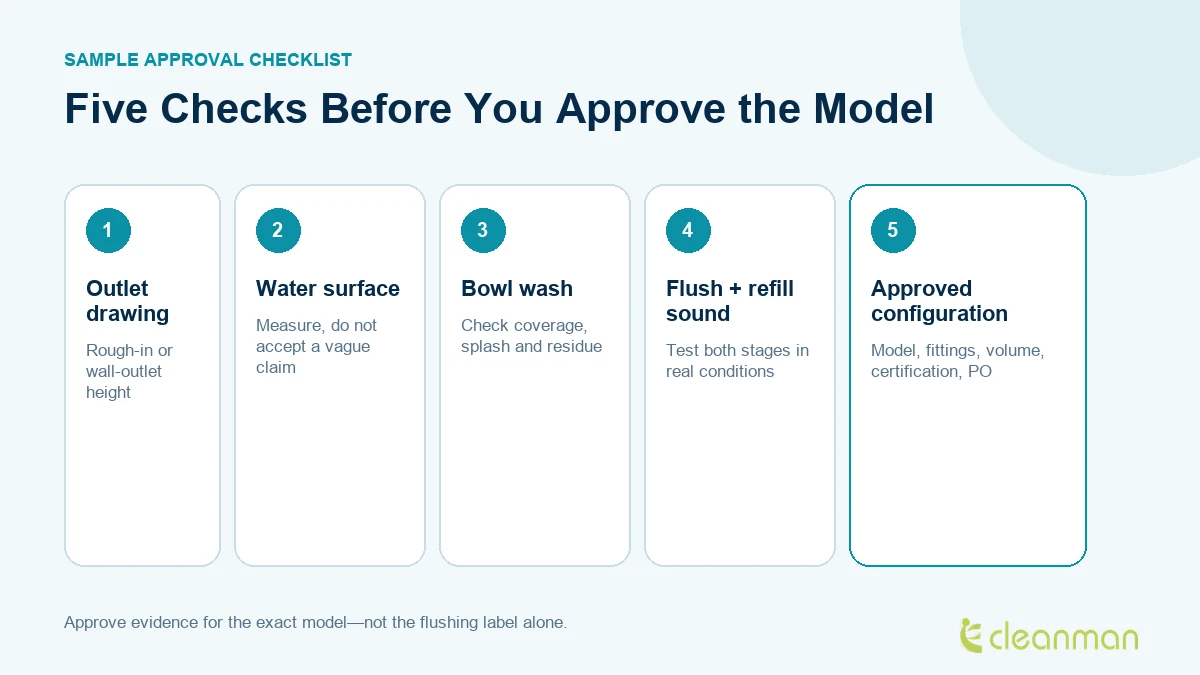
For a floor-outlet model, the order normally records the rough-in distance from the finished wall to the outlet center. For a wall-outlet model, it records the height from the finished floor to the outlet center. Suppliers may describe these configurations as S-trap and P-trap, but the dimension drawing is the safer purchasing reference. Do not treat “siphonic,” “washdown,” “S-trap,” and “P-trap” as four versions of the same specification. The first pair describes flushing behavior; the second pair describes outlet direction.
Ask the supplier for a dimension drawing showing the outlet position. If the project includes several buildings or room types, check whether the order needs more than one outlet configuration.
2. Compare the Actual Water Surface, Not a General Promise
A larger bowl water surface is often one reason a market prefers siphonic toilets. It can reduce the dry ceramic area exposed to waste. A smaller water surface, which is common in washdown designs, may make the bowl easier to adapt to a compact body or different outlet arrangement, but users accustomed to a high water level may consider it unfamiliar.
Do not accept “large water surface” without a measurement. Ask for the water-surface dimensions and water-seal depth for the exact model. Then compare the sample with products already sold successfully in the target market.
3. Do Not Use Flush Volume as a Shortcut for Performance
Two toilets can use the same amount of water and perform differently. Bowl channels, inlet flow, fittings, trapway geometry, glaze quality, outlet connection, and installation conditions all affect the result.
For North American projects, the applicable product configuration may need to comply with ASME A112.19.2/CSA B45.1. The standard covers ceramic plumbing-fixture construction, performance, testing, and markings. EPA also explains that WaterSense-labeled toilets must meet water-efficiency and flushing-performance requirements; the label is not based on water volume alone. Review the current requirements on the EPA WaterSense residential toilet page and the ASME ceramic plumbing fixture standard page.
If a supplier presents a MaP score, confirm the exact tested model and configuration. MaP describes its procedure as a test to failure, so a score should be treated as model-specific performance evidence, not as proof that every toilet using the same flushing label will perform identically. See MaP Toilet Testing’s explanation.
4. Evaluate Noise With a Sample, Not With the System Name
Siphonic toilets are often marketed as quieter because the flush develops as a draw through the trapway. Washdown models may create a shorter, sharper discharge sound. However, the fittings, refill valve, tank insulation, ceramic waterways, room finishes, and water pressure can change what the user hears.
If noise matters for hotels, apartments, hospitals, or senior-living projects, test the complete sample in realistic conditions. Record the flush and refill stages separately. A quiet flush followed by a loud refill valve is not a quiet toilet.
5. Check Cleaning Behavior in the Real Bowl
A siphonic bowl may offer a larger standing water area, while a washdown bowl may depend more visibly on the path of water across the ceramic surface. Neither label proves complete bowl washing.
During sample approval, mark several areas around the bowl and observe whether the flush reaches them consistently. Check under the rim or around the rimless water outlets. Also inspect for splash, residual paper, and marks above the waterline.
This test is especially important when a supplier changes the fittings, flush volume, or ceramic mold after the original sample. The approved combination should be written into the order documents.
6. Match the System to Local User Expectations
A product can pass a laboratory test and still feel wrong for a market. Customers who are used to a deep water surface may interpret a low-water washdown bowl as underfilled. Customers familiar with washdown toilets may prefer their fast discharge and may not value the longer siphonic draw.
Before adding a model to your range, review competitor products in the same price level. Ask distributors and installers what users complain about: marks in the bowl, splash, noise, slow discharge, blockage, or difficulty finding compatible parts. Those answers are often more useful than a general claim that one system is “more advanced.”
7. Put the Complete Configuration on the Purchase Order
A siphonic vs washdown toilet choice is not a complete order specification. Your purchase order or approved specification sheet should identify:
- Model number and approved ceramic mold
- One-piece or two-piece construction
- Siphonic or washdown flushing system
- S-trap or P-trap outlet
- Rough-in distance or wall-outlet height
- Single- or dual-flush fittings and rated flush volume
- Bowl shape, seat material, hinge type, and mounting-hole spacing
- Water-surface dimensions and water-seal requirement, when important
- Required certification and the exact certified configuration
- Approved sample, packaging, spare parts, and replacement fittings
This level of detail prevents a familiar model name from being supplied with a different outlet, fitting set, or flush volume.
Siphonic vs Washdown Toilet: Which Should You Choose?
Choose a siphonic toilet when your market expects a larger bowl water surface and a smoother draw, and when the tested model matches the project’s outlet and performance requirements. Confirm the rough-in, trapway, flush volume, certification, and sample performance.
Choose a washdown toilet when users are familiar with a direct flush and the approved model fits the required outlet arrangement, water conditions, and price position. Confirm the actual bowl wash, water surface, outlet dimensions, and compatibility with local plumbing.

Frequently Asked Questions
1. Is a siphonic toilet always better at preventing clogs?
No. The flushing label alone does not determine clog resistance. Trapway geometry, outlet size, water delivery, glaze, waste load, drain connection, and installation all matter. Compare the exact models through sample testing and applicable performance evidence.
2. Does a washdown toilet always have a larger trapway?
It commonly has a shorter and wider waste path, but you should not rely on the category name. Ask for the minimum fully glazed trapway dimension and inspect the product drawing or section sample.
3. Can a rimless toilet be siphonic or washdown?
Yes. Rimless describes the bowl-edge and water-delivery structure. Siphonic and washdown describe how the flush moves waste through the outlet. Confirm both features separately.
4. Which system is quieter?
Siphonic models are often perceived as smoother or quieter, but the complete toilet and room conditions decide the real sound. Test both the flush and refill stages on an approved sample.
5. Can I buy siphonic and washdown toilets in the same container?
Yes, if the factory accepts mixed-model loading and the quantities meet production and packaging requirements. Keep each model’s outlet, fittings, rough-in, certification, carton marks, and spare parts clearly separated on the purchase order.
Build the Right Mix for Your Market
Your siphonic vs washdown toilet decision can vary by project or product range. You may need siphonic models for customers who expect a larger water surface and a smoother flush, while washdown models may suit other outlet conditions, price points, or regional habits. Send CLEANMAN your target country, outlet requirements, preferred water consumption, certification needs, and current best-selling specifications. We can recommend suitable siphonic and washdown models for comparison and help you narrow the sample list before quotation.

